
Share This Article
Korea's Micro-Drama Boom: How 2-Minute Vertical Dramas Are Becoming K-Entertainment's Next Global Export
Korea's biggest entertainment players are making a mass migration into vertical micro-dramas. With $9.7B globally and Korean platforms growing 324%, this two-minute format could be K-Entertainment's next global weapon.
HITKULTR
February 24, 2026
Korea's vertical micro-drama push is no longer a fringe experiment. In February 2026, Seoul Economic Daily reported that major Korean players including Showbox, CJ ENM's Tving, MBC, and KT Studio Genie were rapidly expanding into phone-first serials built around one to five minute episodes. That matters because the move ties Korea's strongest storytelling infrastructure to one of mobile entertainment's fastest-growing formats. What looked like disposable short-form content a year ago is now drawing real studio investment, known directors, and export-minded strategy. Korea is not entering this market to test a novelty. According to Seoul Economic Daily's reporting, it is entering because the business case has become too loud to ignore and because the country's existing K-drama production machine is well positioned to outclass volume-first rivals on polish, casting, and cliffhanger design.
The numbers explain the urgency. The global short-form drama market reached $9.7 billion in 2024, while Korea's domestic segment was estimated at about $490 million and projected to approach $1.5 billion, according to industry estimates cited by Seoulz. Deadline also reported in April 2025 that micro-drama apps across Asia had passed 150 million monthly active users, underscoring how quickly the format had moved from niche habit to mass behavior. Korean platform counts jumped from 21 to 89 between 2023 and early 2025, a 324% increase, according to market tracking cited in the article. Add Korea's webtoon IP pipeline, payment familiarity, and export-ready production standards, and the boom starts to look less like a trend cycle and more like the next logical extension of the wider Hallyu business model.
The Numbers Behind the Boom
The global short-form drama market hit $9.7 billion in 2024, according to industry tracking cited by Seoulz, and Korea wants a bigger share of that spend. Seoulz estimated the domestic market at roughly $490 million last year with a path to $1.5 billion, while the same reporting noted Korean viewer adoption of short-form dramas jumped from 58.1% to 70.7% in a single year. Deadline separately reported in April 2025 that micro-drama apps had crossed 150 million monthly active users across Asia. Those figures matter because they show the format is not being sustained by curiosity alone. It is being supported by repeat viewing, aggressive app expansion, and a monetization model that mobile-native audiences already understand.
Globally, micro-drama apps crossed 150 million monthly active users, as reported by Deadline. Korean platforms themselves multiplied from 21 to 89 between 2023 and early 2025, a 324% increase according to industry tracking cited by Seoulz. The infrastructure for a content explosion is already in place.
What Korean Micro-Dramas Actually Look Like
The format borrows from mobile gaming more than traditional television. Episodes run one to five minutes, shot entirely in vertical for phone screens, and monetized through coin-based payment systems where viewers unlock episodes one by one. The genres lean into classic K-Drama territory: romance, revenge, billionaire fantasies, reincarnation stories. Think of it as the emotional density of a full K-Drama compressed into a commute-length binge.
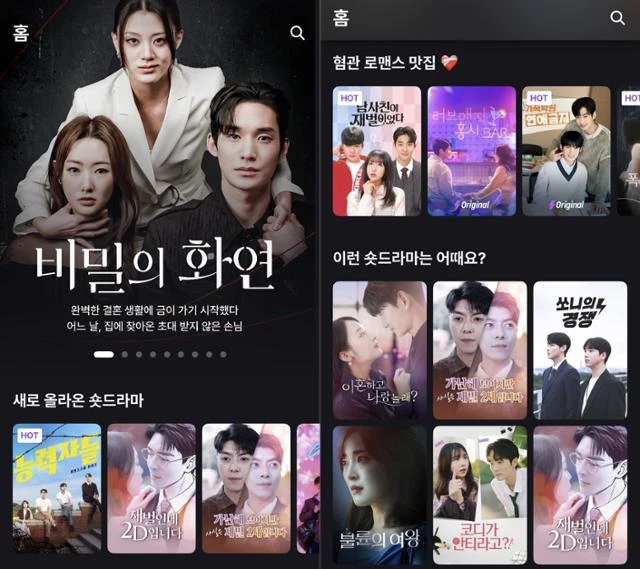
China pioneered the format. Apps like ReelShort, DramaBox, and ShortMax built the playbook and proved the business model could scale. But Korea is entering this market with a different proposition entirely: production quality. Where Chinese platforms often prioritize volume and speed, Korean studios are applying the same polish that turned K-Dramas into a global phenomenon.
The Key Players Making the Push
Vigloo: The Frontrunner
Vigloo, operated by SpoonLabs, is the most aggressive Korean player in the space. Backed by $86 million from gaming giant Krafton, the company behind PUBG, Vigloo produced roughly 200 original vertical dramas in 2025 and plans to double that to 400 in 2026. More than 70% of its revenue comes from overseas markets, according to ContentAsia, and the company is opening an L.A. office to anchor its American expansion.
CJ ENM and Tving Short Originals
CJ ENM launched Tving Short Originals in August 2025, producing series with two-minute episodes across 60-episode runs. When one of Korea's most powerful entertainment conglomerates, the company behind tvN and Mnet, commits resources to a format, the industry takes notice.
KT Studio Genie's Global Debut
KT Studio Genie, the content arm of Korean telecom giant KT, entered the short-form space with immediate results. Its debut titles hit number one on DramaBox and ReelShort respectively in early 2026, as reported by The Korea Times, proving Korean content can dominate even on Chinese-owned platforms.
Showbox and the Film-to-Short Pipeline
Showbox, one of Korea's major film distributors, signed MOUs with DramaBox and Beglu to produce short-form content. Meanwhile, a new platform called Sero (세로본능) launched in February 2026, as reported by The Korea Herald, taking a different approach by repackaging existing Korean films and series into vertical-format episodes. The word sero means vertical in Korean.
Star Directors Jump In
Perhaps the strongest signal that this format has cultural legitimacy is Lee Joon-ik's involvement. When directors of that caliber enter a space, it stops being a novelty and starts being treated like a medium.
Why Korea Could Win This Market
Korea has three structural advantages that no other country can replicate easily.
First, the webtoon pipeline. Korea's massive webtoon industry produces thousands of serialized, visually driven stories every year, many of them already structured in short, cliffhanger-heavy chapters. Adapting webtoon IP into two-minute vertical episodes is a natural fit, and Korea has decades of IP ready to convert.
Second, production infrastructure. The studios, directors, actors, and post-production houses that power K-Dramas and K-Films are world-class. Applying that talent to micro-dramas gives Korean content a quality edge that pure volume plays from other markets cannot match.
Third, the payment model is familiar. Korean audiences are already conditioned to coin-based microtransaction systems through webtoons, mobile games, and music platforms. The unlock-the-next-episode mechanic that drives short-form drama revenue is second nature to Korean consumers.
The $9.7 Billion Question
The real test is whether Korean micro-dramas can do what K-Dramas, K-Pop, and Korean cinema have already done: convert global attention into global revenue. Sensor Tower's data on short drama app growth suggests the audience is there. Vigloo's 70%+ overseas revenue mix proves the demand exists.
The next 12 months will determine whether Korea's micro-drama push becomes K-Entertainment's next global export or a footnote in the streaming wars. Based on the investment, the talent, and the infrastructure now committed to this format, the smart money is on the former. Korea does not enter markets to participate. It enters to dominate.