Share This Article
CJ ENM's StudioMonowa Could Become K-Content's Most Important Japan Pipeline Yet
CJ ENM's new StudioMonowa venture with TBS and U-NEXT is built to turn Japanese IP, Korean production systems, and local streaming scale into a serious 2026 premium-content pipeline.
May 4, 2026
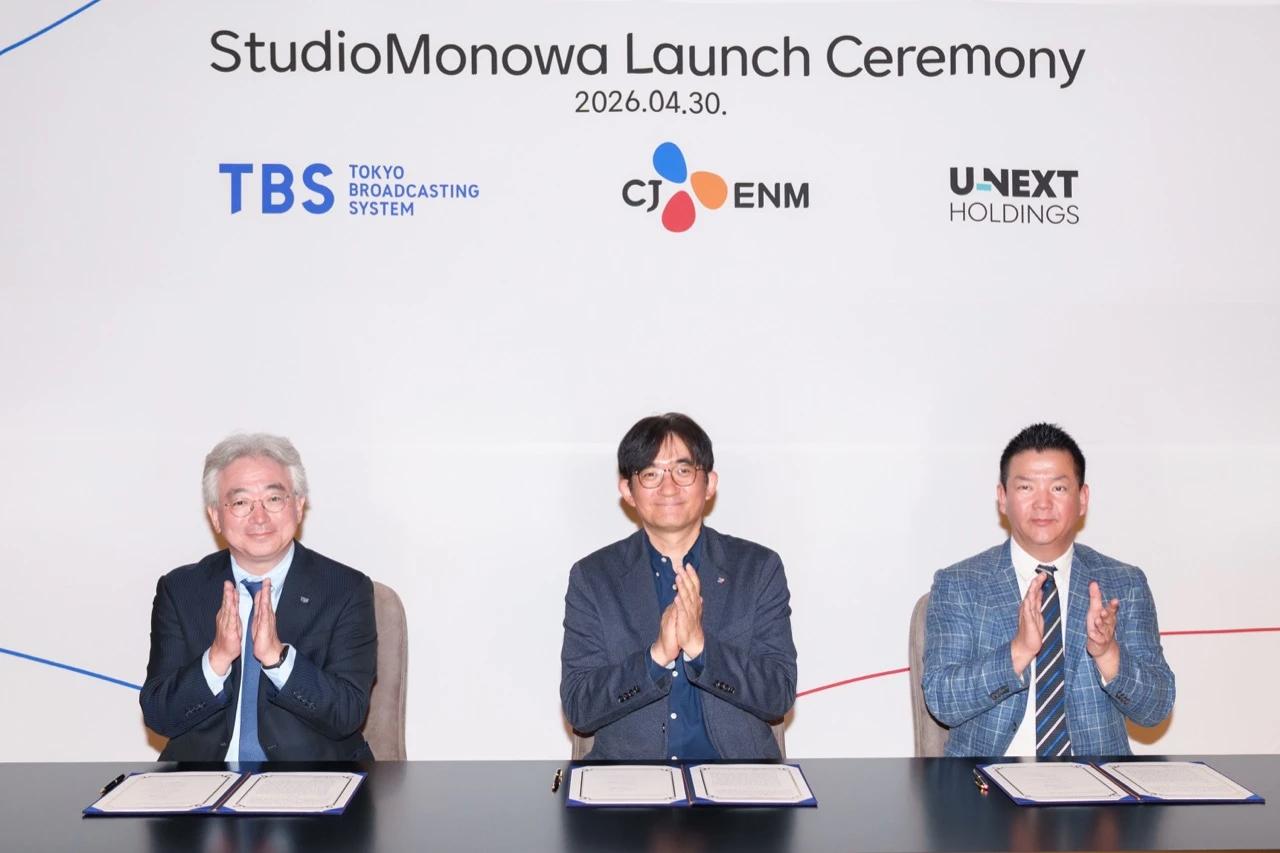
CJ ENM has formally launched StudioMonowa with TBS and U-NEXT after an April 30 signing ceremony in Seoul, and the joint venture already looks bigger than a routine cross-border press release. According to CJ ENM’s official announcement and The Korea Times, the new company is designed to control the full value chain from original IP sourcing and development to production, distribution, and spin-offs. The launch was attended by CJ ENM CEO Yoon Sang-hyun, TBS President and CEO Abe Ryujiro, and U-NEXT CEO Tsutsumi Tenshin, which tells you this was a board-level move, not a symbolic memorandum. That matters because Japan is not just a licensing stop anymore. It is a premium IP market that CJ ENM values at about KRW 67 trillion, with streaming expanding 20.5% annually. If StudioMonowa executes, it could become the cleanest Korea-to-Japan pipeline yet for turning local stories into global screen franchises instead of one-season export wins.
StudioMonowa's real edge is structural, not cosmetic. This is not one broadcaster buying a remake format or one platform licensing an overseas slate for a single season. According to CJ ENM's May 1 release, the venture splits responsibilities in a way that already mirrors a full value chain: CJ ENM leads planning and creative differentiation, TBS leads original Japanese IP sourcing and related business expansion, and U-NEXT handles platform distribution. Variety reported the same division and added that U-NEXT brings more than 5 million paid subscribers and a library topping 440,000 titles. That setup gives the studio upstream access to Japanese stories, Korean production muscle, and a built-in domestic outlet from day one. It also gives each partner a clearer commercial reason to stay aligned after launch. StudioMonowa pushes the broader Korea-to-Japan pipeline trend into a much more tightly owned operating structure.
StudioMonowa is being built to monetize IP far beyond premiere night
StudioMonowa is being framed as a lifetime-value business from the start, which is why this launch feels more important than the average corporate JV. As reported by Variety and confirmed by CJ ENM, the studio is meant to run projects across sourcing, investment, scripted production, global distribution, derivative works, and spin-off businesses rather than cashing out at first release. That model gives TBS a stronger monetization lane for Japanese original IP, gives CJ ENM another place to apply the production discipline that made K-dramas exportable, and gives U-NEXT exclusive leverage as both audience gateway and feedback loop. It also creates more room for remakes, merchandise, and sequel planning to live inside one coordinated system instead of separate deals. In plain terms, the venture is trying to own more of the upside after the first stream, not just the opening headline. That is a much smarter bet than treating Japan as a simple remake market.

CJ ENM is using proven Japan traction to lower the risk on this expansion
CJ ENM is not entering Japan cold, and that history is what makes StudioMonowa credible. CJ’s own release pointed to the Japanese remake of Amazon’s Prime Video series Marry My Husband and its TBS collaboration Love is for the Dogs through Studio Dragon as proof that its glocal production model already travels. Variety also noted that TBS is treating global partner development as a strategic priority under its Medium-term Business Plan 2026, while U-NEXT brings more than 5 million paid subscribers and a library topping 440,000 titles. That combination matters. One partner knows how to industrialize premium Korean drama. One partner controls domestic Japanese IP relationships. One partner already owns the customer pipe. Put together, StudioMonowa looks less like a symbolic alliance and more like a serious attempt to decide where the next wave of Korea-Japan premium series gets built.
The bigger takeaway is that 2026 K-content strategy is shifting from export to infrastructure. According to CJ ENM's release, the companies want one operating structure to control discovery, development, production, platform access, and the second life of an IP after release. Variety's reporting points the same way by stressing lifetime-value planning instead of first-window licensing. That matters more than the signing-ceremony optics. The winners in this cycle will not just be the companies that make a hit series. They will be the companies that own the pipe between local story mining and global monetization across multiple release stages. That is a harder business to build, but it is also where the long-tail value sits once hits start moving across territories. StudioMonowa still needs breakout shows before anyone crowns it a regional power center, but the commercial logic is already sharper than a simple remake pact or one-off co-production deal.