Share This Article
SONGZIO's "Lyrical Armor" Dressed BTS for the ARIRANG Comeback
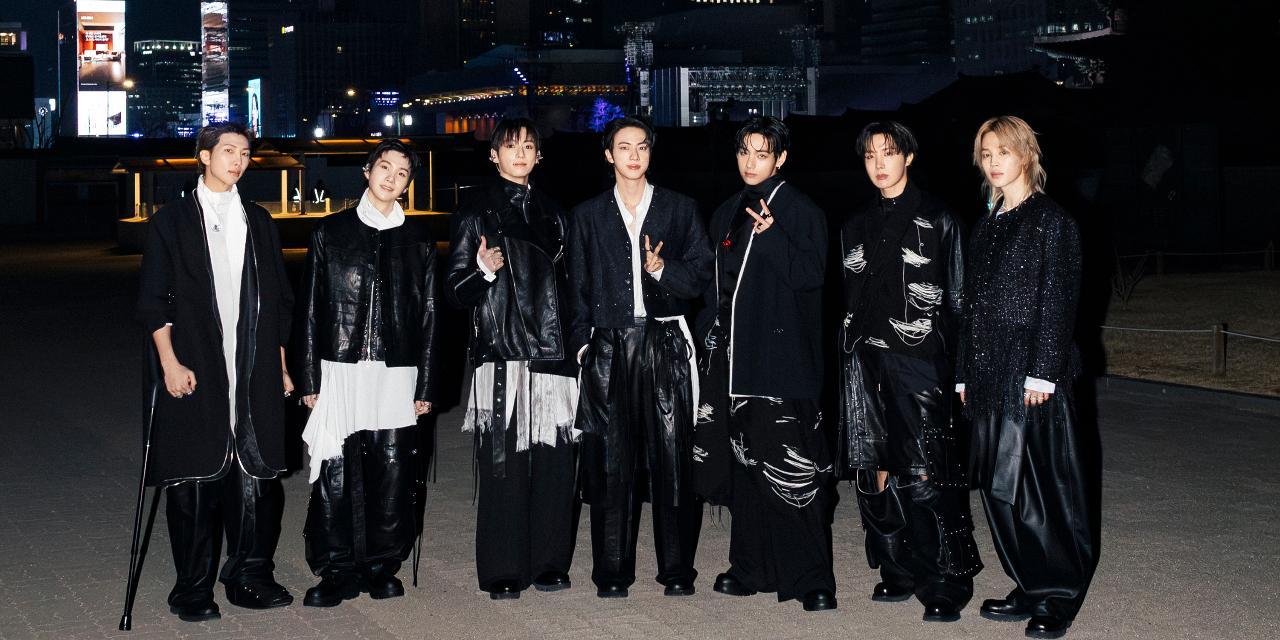
Korean designer Jay Songzio built 80 custom looks rooted in Joseon-era armor and traditional folk garments for BTS's historic Gwanghwamun comeback concert on March 21, 2026.
March 24, 2026
Korean designer brand SONGZIO (송지오) dressed all seven members of BTS (방탄소년단) for their landmark comeback concert, "BTS THE COMEBACK LIVE | ARIRANG," staged on March 21, 2026 at Gwanghwamun Square in central Seoul to an in-person crowd of approximately 40,000 fans and a global Netflix audience of millions. The collection, titled "Lyrical Armor," was developed after HYBE approached SONGZIO creative director Jay Songzio approximately two months before the event, as Jay Songzio confirmed in an exclusive interview with WWD. This marks the first time SONGZIO conceived an entire visual concept for BTS from the ground up, rather than pulling from existing seasonal collections. Drawing on early Joseon Dynasty armor and traditional Korean folk garments, the designs clothed not just the seven members but all 80 performers on stage, including traditional dancers, vocalists, and instrumentalists, creating a unified visual identity across the entire production that anchored the show's deeply Korean identity.
The Concept: Korean Sorrow as Structural Language
Jay Songzio built "Lyrical Armor" around a single emotional core: "han" (한), the deeply Korean concept of unresolved sorrow, longing, and resilience passed down through generations. For the ARIRANG concert, held at one of Seoul's most historically charged locations, that emotional weight had to be visible in every seam. According to SONGZIO, the collection envisions BTS not merely as performers but as cultural figures carrying the accumulated weight of Korea's history while simultaneously shaping its future. The structural language draws on Korean armor worn during the early Joseon Dynasty (1392-1910), known for its studded construction and layered protection. Asymmetrical silhouettes, exposed seams, and fluid drapery reference traditional Korean ceremonial garments (hanbok) associated with artists and folk singers. The entire collection was executed in a strict monochromatic palette of black and white, a deliberate choice, as the Korea Herald reported, to let construction and silhouette define the visual field rather than color.
Seven Archetypes, One Stage
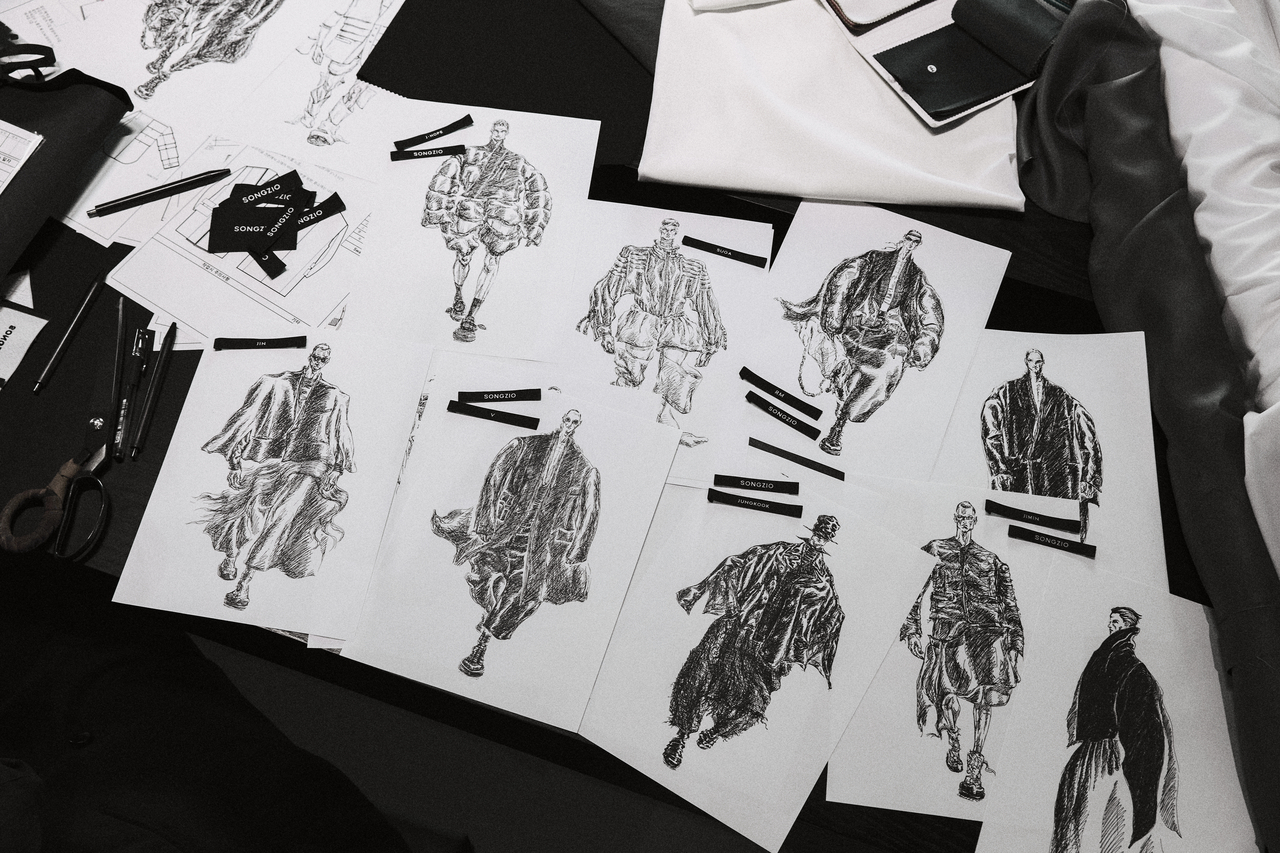
Rather than dressing BTS as a uniform group, SONGZIO built the collection around seven distinct archetypes, according to Korea JoongAng Daily. Jay Songzio explained that one keyword originally proposed was "warrior," but the team unanimously pushed back. "One key word that nobody wanted for some reason was 'warrior,' so I changed that to 'hero,'" Jay Songzio told Korea JoongAng Daily. RM (김남준) was assigned the archetype of the hero, reflecting his role as the group's leader. Jin (김석진) embodies the artist. Jimin (박지민) carries the poet. SUGA (민윤기) represents the architect. Jungkook (전정국) is the vanguard. J-Hope (정호석) draws from the tradition of Korean poet-singers ("sorigun") who expressed emotion through verse and performance. V (김태형) is cast as the refined nobleman archetype ("doryeong"), a figure of Joseon-era aristocratic sophistication. Each archetype directly shaped the silhouette, construction, and fabric choices specific to that member's look.
80 Outfits, Custom Fabric, Two Months
The scale of the project was significant. Reddit's r/bangtan community flagged what fans found most impressive: approximately 80 outfits, custom fabric developed in-house, all delivered in around two months. The costume design extended beyond the seven members to cover every performer on stage, including background dancers, traditional Korean vocal performers known as pansori artists, and instrumentalists. This total-stage approach was intentional, as reported by The Straits Times: SONGZIO positioned costume as an organizing element of the performance itself, not a decorative afterthought. The visual composition created a single, coherent world on stage, with BTS at the center and every surrounding performer reinforcing the same cultural narrative. Construction began through fragmentation: traditional forms were broken into components and reassembled into abstract silhouettes. Layering introduced depth, while volumes shifted around the body to create sculptural forms that caught light and movement differently across the concert's runtime.
The Brand Behind the Collection
SONGZIO was founded in Seoul in 1993 by designer Song Zio, establishing itself as one of Korea's first luxury fashion labels to build a serious presence in Paris. The brand operates more than 100 stores worldwide, including flagship locations in Paris and Seoul, and is set to open a New York flagship later in 2026, according to The New York Times. Jay Songzio, the founder's 30-year-old son, now serves as CEO and creative director, bringing an avant-garde, architecture-influenced design sensibility that aligns with the structural ambitions of "Lyrical Armor." The BTS commission is the brand's highest-profile project and its most public statement yet of SONGZIO's standing as a bridge between Korean heritage and global contemporary fashion. For Jay Songzio, HYBE's approach felt like a natural alignment: "For them, this historical comeback was very important, in that even the title of the album is 'Arirang,' which is one of the oldest and the most traditional Korean folk songs," he told GMA News.
Fan Reaction: The Internet Processed the Looks
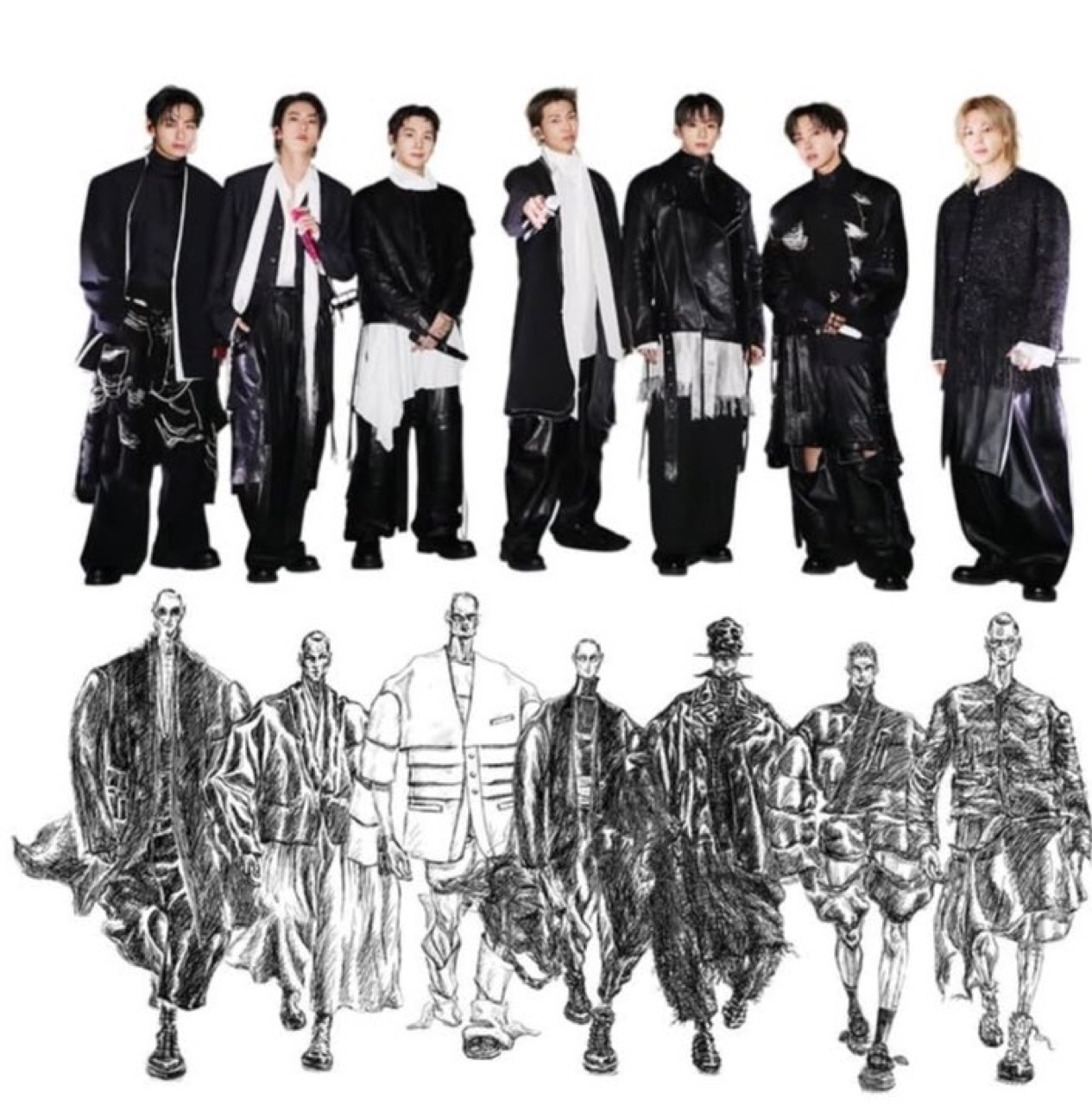
K-fans on X split between reverence and obsession within hours of the March 21 concert. The archetype breakdown became its own thread economy on Reddit and Weverse, with fans dissecting which structural details corresponded to each member's character. The sketch-to-reality composite image, showing SONGZIO's ink illustrations alongside the finished looks, spread widely across fan accounts. Consensus on the design direction was unusually unified for a K-pop costume release: the "Lyrical Armor" concept, and its explicit grounding in Korean cultural history, resonated as exactly the right visual language for a comeback centered on ARIRANG, one of Korea's oldest and most emotionally loaded folk songs. Several fashion commentators noted that the monochromatic discipline showed unusual restraint for a K-pop stage production, and that the restraint paid off.
What's Next: World Tour Looks in Development
The Gwanghwamun concert was the opening statement, not the full chapter. The BTS WORLD TOUR ARIRANG, which runs through March 2027 across 82 dates in 23 countries, will feature a distinct costume direction. Jay Songzio has indicated that a second chapter of the visual concept is in development, with the Korean flag as a reference point for what a group costume could look like on a global stadium stage. Whether SONGZIO continues as the tour's wardrobe partner has not been officially confirmed, but given the critical response to "Lyrical Armor," the pressure to maintain that visual standard is real. BTS's ARIRANG era is the most significant K-pop cultural moment of 2026. The costume design is already part of that story.